I am the wrong person to write about tarot journaling.
I have great intentions. I'm a terrible journaller.
I've started maybe nine tarot journals. Beautiful ones. One had a moon embossed on the cover and cost more than the deck. I think I got four entries in before it went behind the bed, where I assume it still is.
The readings were in one notebook. The reflections were in the notes app. The coincidences were nowhere, because I told myself they were too strange to write down and too obvious to forget.
I forgot all of them.
So this isn't a piece about discipline. I don't have any. It's about the smallest version of the thing that survived me.
The Card Is a Mirror
Here's what the writing is for.
You draw the Lovers. You can look up what the Lovers means, and you should, and that's the tradition talking. What the journal asks is different: what does this card mean here, with what's on my mind today?
The Lovers might be a relationship. It might be a choice you've been avoiding for a month. It might be about your work, or a friendship you've outgrown, or the fact that you keep saying yes to things you don't want.
Then the part most people skip. What might this touch? Not what will happen. What in my life is this already sitting next to. Something behind me I haven't finished with. Something in front of me I've been circling.
The card doesn't tell you. It gives you somewhere to look. Writing is how you record what you saw before you talk yourself out of it, because you will. I'd draw a card on a Tuesday and by Friday I'd have decided it meant something more comfortable than what I felt when I turned it over. My brain does the editing before I notice.
Writing catches the version. What I thought on Tuesday, before Friday got to it.
The Smallest Version That Works
Three lines.
What I see is a description, not an interpretation. A woman turned away. Nine swords on a wall. Write it before you look anything up, because once you know what the book says you can't unsee it, and your own eyes had something first.
What it shows me is one sentence connecting the card to whatever's going on.
What I'll notice is the thread. One thing you're keeping an eye on because the card raised it.
Here's one of mine, more or less as I wrote it.
Nine of Swords. Crowley called it Cruelty.Figure sitting up in the dark, swords hanging over them, hands at their face. The swords aren't touching anyone. They're waiting.
Nothing has happened. That's the part I don't want to write down. I've been awake for three nights about a conversation that hasn't occurred, and I've had it forty times in my head, and none of them were real.
Notice: how much of this week I spend rehearsing.
Eighty words, written on the kitchen floor at 2am. No craft in it. A year later I can read it and know exactly where I was.
An entry doesn't have to be beautiful. It has to be findable.
Tarot Journal Prompts
Some days the three lines come out on their own. These are for the days they don't.
- What's the first thing my eye went to?
- What's happening just outside the frame?
- If this figure could speak, what would they be tired of explaining?
- What does this card mean to me, today, holding this question?
- Where does this show up in my week?
- What would I have to admit for this card to be right?
- What am I hoping it doesn't mean?
- When did I last see this? What was I asking then?
- What's different about me since?
- Am I annoyed it’s here? Why?
- What is this asking me to look at?
- Where am I already living this?
That last pair matter more than the rest. A hard card doesn't need softening. It needs somewhere to land.
Echoes
Then there's the other half, and it's the half I lost every time.
Carl Jung had a word for it. In 1952 he published an essay called Synchronicity: An Acausal Connecting Principle, written alongside the physicist Wolfgang Pauli. The argument was that some coincidences are more than coincidence. Two things line up, neither causes the other, and the meaning is the whole connection.
His example came from his own consulting room. A patient whose hard rationalism had stalled the work was describing a dream in which she'd been given a golden scarab. As she spoke, a beetle began tapping at the window, a rose chafer, the nearest thing Switzerland has to a scarab. Jung caught it and handed it to her. Here is your scarab. Nothing caused anything. The treatment moved anyway.
We call them echoes in Enchantra. Same idea, less Latin.
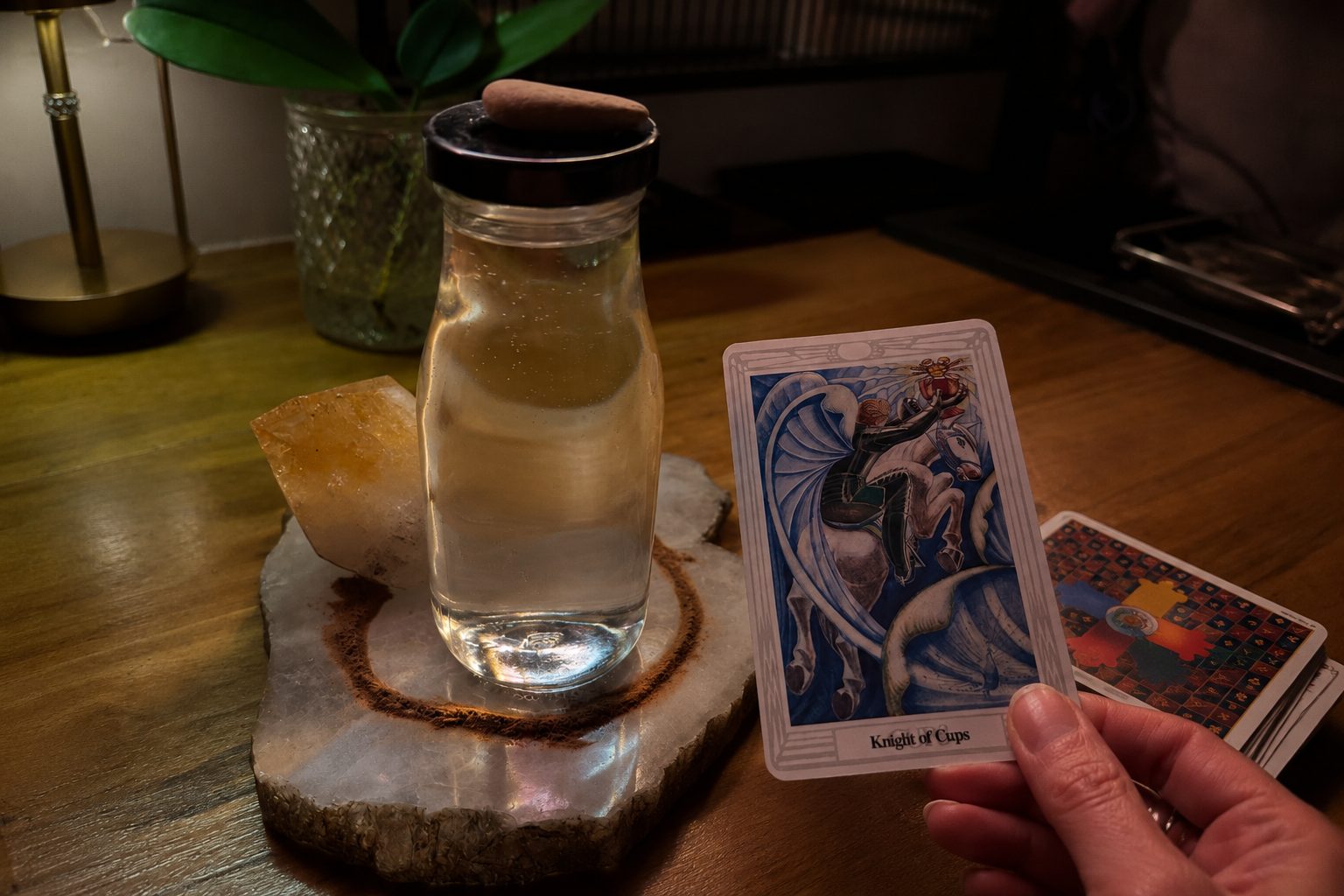
Mine are kookaburras. I'll see one, then four more that week, then a pair on the fence while I'm on a phone call I've been putting off for a month. 11:11. 23:23. The same person on the same street three times in a fortnight. The same song in the car, every time, on the drive to the same place.
There's a flat explanation for all of it. Humans are pattern-finders. You notice the kookaburras in the week you're primed to notice them, and the ninety other birds go unrecorded. There's a name for that, apophenia, and it's a real thing your brain does to you.
I know there's a scientific explanation for some of this and another kind of explanation for the rest, and I'm not sure where one ends and the other begins. I write them down anyway. Both explanations ask the same thing of me: that I noticed, and that I can prove what I noticed and when.
An echo is a line. That's all.
Written next to the reading, not somewhere else. That's the whole trick, and it's the one I could never manage.
Why Enchantra Has a Journal In It
Because I was terrible at this, and not in a charming way.
The cards were in one place. The reflections were in another. The echoes were in my head, where they dissolved. I never once, in nine notebooks, sat down and read the whole thing back. So the pattern that would have been obvious across four months was never obvious, because the four months were never in the same room.
What I wanted was something to catch what I wasn't catching. Not to tell me what it meant. To say: the Nine of Swords has come four times this year, always the week before something you're dreading, and here's what you wrote each time.
So in Enchantra the journal is attached to the card you drew. The echo is attached to the reading it followed. Nothing lives in a separate notebook, because separate notebooks are how I lost years of practice.
You can do this on paper. Once a month, read the cycle back. Ten minutes. Look for the card that repeated, the word you used three times without meaning to, the echo you wrote down and then ignored.
I know you probably won't. I didn't.
What This Isn't
A journal doesn't make you better at tarot.
It isn't a record of what the cards mean. Half of what I've written is wrong, in the sense that I'd read it differently now. That's the point of having it.
An echo isn't a message and it isn't an instruction. Seeing a kookaburra doesn't mean take the job. Writing it down is not the same as obeying it.
And this isn't therapy, or a substitute for it. Writing down a hard feeling isn't the same as being helped with it. If you're depressed, see a therapist. If you're not safe, talk to someone who can help you be safe. A journal will hold the sentence. It won't hold you.
When People Ask
What the Writing Is For
Every time you write it down, you're choosing to keep the version you had before it gets edited into something easier.
You're choosing to be specific when a vague feeling would be more comfortable.
You're choosing to leave yourself evidence.
The cards will keep coming back, and so will the kookaburras. Whether that means anything is yours to decide, and you can't decide it from memory.
If you take one thing today: write three lines, and write down the coincidence.